It is the terrible glory of a free nation such as ours that a lowly frazzle-haired tyro like me can stand athwart the azimuths of the powerful and express unsolicited opinions about the way the affairs of the world might be improved upon. I rarely do so publicly, although I’m occasionally tempted, mainly because I see too many of us rush headlong to one side or the other of any number of false dichotomies: you HAVE to believe either THIS or THAT…which one are you?? The socials browbeat a bro into believing that he has to be indubitably one billion per cent for or against something, even though a little calm reflection reveals that there are all kinds of morally and intellectually satisfying middle roads.
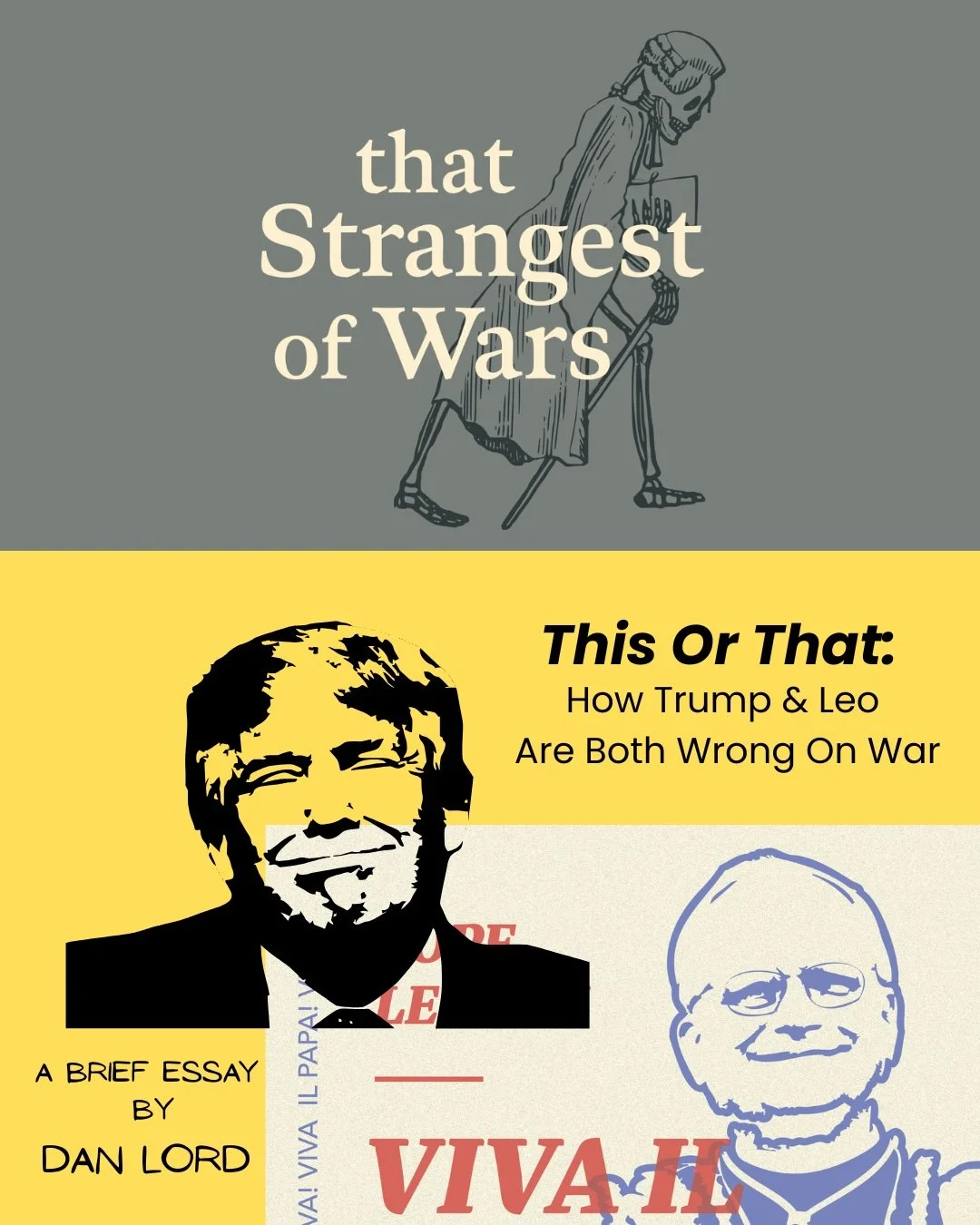
Anyway, as we’re all well aware, President Trump has chosen to invade Iran, and I think that was a bad decision. I’ve listened to the administration’s attempt to justify it, and I’ve been perplexed by how wispy it is, and how recklessly it’s been framed. Iran has been in the chokehold of wicked, violent men for a long time, but that alone doesn’t justify an invasion. The Ayatollahs would, if they could—I’m sure—pour bombs all over us if they thought for a moment they could get away with it, but that also doesn’t justify an invasion—or if it does, then we’d have to simultaneously invade China, Russia, several African nations, probably Central America, and maybe even California. Actually, as I remember it, one initial attempt at justification was Secretary of State Marco Rubio telling the American people (sorry, I’ll need to paraphrase here): “Israel was going to attack Iran; we told them not to, because if they did then Iran would retaliate against the U.S.; but Israel said they didn’t care and they would attack Iran, anyway; so WE said ‘well, then we’ll have to attack Iran before they attack us because Israel attacked them.’ See? It’s a pre-emptive strike.” Nevermind that I don’t believe in the morality of a pre-emptive strike (because then any nation could justify any invasion any time they wanted), but the screams of logic being so brutally tortured were deafening. Oh well, off to war we went. Nobody but a comparative handful of Christian Zionists and Israeli nationalists were very happy about it, but c’est la vie: the elite run the world, and the rest of us mostly just scurry around in their shadows.
However, if Mr. Trump is the “This” in this scenario, then Pope Leo XIV is the “That.” A recent anti-war quote by him now in heavy circulation is being regarded by many as a response to the war in Iran, and also being seized upon by the False Dichotomy People: “You’re indubitably one billion per cent on the pope’s side, or you hate peace and you love MURDERRRR!” Nevertheless, I must object. I’m a Catholic, so I get to lob whatever constructive criticism I like at the Pope, even though many of my co-religionists will see it as de facto heresy, or at least shameful disloyalty. They’re wrong. Canon Law says I can’t punch a pope, but I can (charitably) rebuke him as much as I see fit if he bungles his teaching office. Catholics criticizing popes is a tradition that stretches all the way back to St. Paul—re-read Galatians 2, when Paul rebuked Peter for preferring Jewish Christians to Gentile Christians, even though Peter had formally pronounced that there was no difference. For that matter, Jesus Himself criticized the pope: a few verses after making Peter “the Rock” upon which He’d build His Church, He blasts Pete for trying to stop Our Lord from going to Jerusalem to be crucified. Criticism of the pope is a Catholic’s sacred duty, when called for, so that’s what I’m exercising here.
Pope Leo’s much-repeated quote in question, that God “does not listen to the prayers of those who wage war, but rejects them, saying: “Even though you make many prayers, I will not listen: your hands are full of blood” is from a homily he gave at St. Peter’s Square on Sunday, March 29. The homily, on the whole, is quite beautiful, and lovingly expressed. It never explicitly mentions any particular war, but decries violence and laments the plight of innocent victims of war. Still, it isn’t a stretch to think that Leo has the destruction in Iran in mind. The question is: is what he said right?
In the case of that one isolated quote, I say “no.” Let’s look at the full quote:
Brothers and sisters, this is our God: Jesus, King of Peace, who rejects war, whom no one can use to justify war. He does not listen to the prayers of those who wage war, but rejects them, saying: “Even though you make many prayers, I will not listen: your hands are full of blood” (Is 1:15).
It’s probaly vital to point out that the Catholic Church is not pacifist. We don’t believe that non-violence is an absolute. In the Old Testament, our spiritual ancestors, the Jews, often fought battles which they called just, and their victories were blantantly ascribed to God’s blessings.
For instance, in the book of Exodus, Moses led his people in a battle against the Amalekites, and everybody discovered quickly that the Israelites’ success or failure was dependent on Moses physically keeping the staff of God raised above his head in a steadfast appeal to the Almighty. With help from others, Moses kept his trembling arms upraised, and God granted them victory. Which is good, because the Amalekites wanted nothing other than to wipe the Israelites out.
Another example is the 1st Book of Maccabees (my Protestant chums won’t be familiar with this one, because it isn’t in their modern Bibles, but bear with me). In Maccabees, the Greeks have subjugated the Israelites of the 2nd century, crushed them physically and spiritually into submission, capping it off by putting a big, fat pagan statue inside the Holy of Holies. Wicked stuff. But the Jewish people rose up gloriously and defeated the Greeks—this is commemorated every year by faithful Jews during Hanukkah. In other words, the Israelites waged war, and asked God to bless them, and He did. God did not tell them that their “hands were full of blood.” When God said that in the passage from Isaiah that Pope Leo references, He was speaking specifically by way of the prophet to the Israelites of the 8th century B.C., who at the time had lapsed into a nation of sinful apostates.
The Catholic Church formally teaches that waging war is sometimes not only permissible but obligatory. This is called jus ad bellum. Just War. The conditions for it were formulated by St. Augustine in the 4th century, but he wasn’t just making the idea up ex nihilo—he was drawing from a demonstrable tradition present in Judeo-Christian history. Evil must be resisted. There are times when we MUST physically defend what is good and innocent against evil, violent people. I like the quote from Judas Maccabeus that I mentioned in my book, Choosing Joy: “With great presumption and lawlessness they come against us to destroy us and our wives and our children and to despoil us; but we are fighting for our lives and our laws. [The Lord] himself will crush them before us; so do not be afraid of them.” It’s O.K. if you hear Samuel L. Jackson in Pulp Fiction when you read that; I do too, sometimes.
Let’s also not forget about Leo XIV’s own distant predecessor, Pope Pius V. In 1571, the Ottoman Empire was about to lay total and complete waste to southern Europe. It was an exisitential threat, not some quibble over territory. Europe was on the verge of annihilation. Worse, European nations couldn’t seem to organize themselves, mired as they were in political and tribal quarrels. It was Pope Pius V who created the Holy League, appointing Don John of Austria as its commander, and stirring them to rise up in one epic maritime showdown now known as the Battle of Lepanto. The Ottomans had been enslaving people, conquering peaceful nations, and being generally evil for centuries, and they should have won that fight, hands down. Overwhelmingly. They had a huge, superior naval force; Europeans were utterly outmatched. How did the Holy League win? You don’t have to believe this, but THEY sure did: for the day of the battle, Pope Pius V had everybody pray the rosary at the same time. God, being He who can accomplish the impossible, blessed the Holy League, and the Ottoman navy was smashed. The Catholic Church officially put a day on the Church calendar to celebrate the fact that God helped them fight and win that war: October 7, the Feast of Our Lady of Victory.
Would that quote from Pope Leo’s homily have made the faintest sense to Pius V? Is it always absolutely wrong to wage war? Does God truly never hear the prayers of those begging for victory in combat against villainous oppressors?
So, Mr. Trump is wrong for taking us to war against Iran—I don’t believe it is justified, judging by the Church’s age-old formulation which stipulates, among other things, that war must be a last resort—“all other peaceful means must have been shown to be ineffective.” Innocent people in the Middle East are now paying the price, as are our military men and women: 13 killed and about 200 wounded, so far. But Pope Leo—with all due respect—is not faithfully expressing what the Church teaches about waging war, either. There IS “a time of war.” I don’t think this is it, but it isn’t “never,” either, unfortunately. Like the Joker in The Dark Knight, some people don’t want to dialogue or come to a peaceful resolution. Some people just want to watch the world burn. If it comes to that, and all other peaceful means have been shown to be ineffective, then we should definitely pray that God gives us the strength to fight back.